 |
Snap4Tourism
|
|
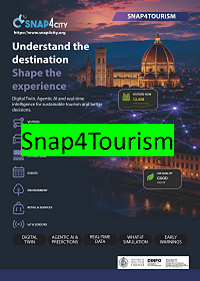
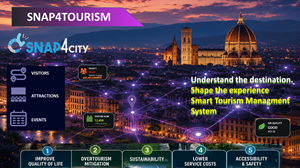
Tourism is a major driver of urban attractiveness and economic development, and creates complex challenges for city operators: overcrowding at cultural attractions, pressure on mobility and public spaces, seasonal peaks, impacts on residents and heritage, and an uneven distribution of visitors and economic benefits across the city. Snap4Tourism is an integrated Smart Tourism and Destination Management environment that enables cities to observe what is happening, understand why, anticipate what may happen next and identify the most effective actions. PDF: https://www.snap4city.org/download/video/snap4tourism-2026-v07.pdf |
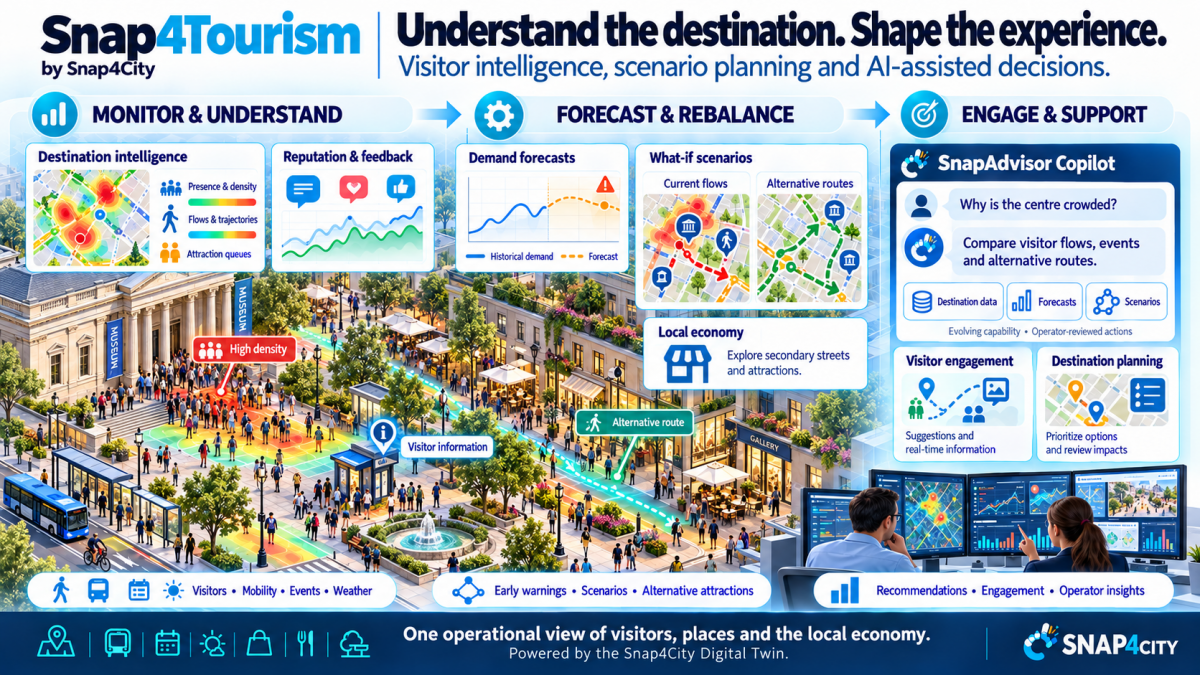
At its core, the Snap4City Digital Twin integrates heterogeneous public and private information—including visitor and pedestrian flows, mobility and parking, public transport, environmental conditions, events, cultural attractions, accommodation, commercial activities, IoT devices and other city data—into a continuously updated operational representation of the destination. Artificial Intelligence, predictions, anomaly detection, simulations, optimization and what-if analysis transform these data into actionable intelligence for city and destination managers.
A Tourism Control Room that understands the destination
With Snap4Tourism the operators can monitor visitor presence, density, trajectories, origin-destination patterns and hotspots, connecting tourism dynamics with mobility, environmental conditions, events and city services. Predictive models and early-warning mechanisms can identify emerging congestion or critical conditions, while Digital Twin simulations allow operators to evaluate alternatives before interventions are implemented. The platform can calculate origin-destination patterns, identify overcrowding, analyse the use and reputation of services and generate forecasts and early warnings when predefined thresholds or potentially critical conditions are detected. This transforms tourism management from periodic reporting into an operational process. A city operator can quickly answer questions such as: Where are visitors concentrating now? Which areas may become congested in the next hours? How are tourism flows interacting with traffic, parking or public transport? Which attractions or alternative areas could absorb part of the demand?
These capabilities have been validated through major European initiatives. In HERIT-DATA, Snap4City supported destinations including Florence, Valencia, Dubrovnik, Pont du Gard, Mostar and Ancient Olympia, combining tourism KPIs, people flows, mobility, social-media and other data into customizable indicators and real-time dashboards designed to reduce the negative impact of mass tourism on cultural and natural heritage. Building on this experience, TOURISMO – TOURism Innovative and Sustainable Management of flOws applies advanced monitoring and decision-support approaches in Mediterranean pilot destinations including Florence, Valencia, Varna, Rhodes, Biševo, Limassol and Malta. The project integrates data with technologies such as thermal cameras, passenger counters, drones and tags to better understand tourist presence, density, trajectories and behaviour.
Snap4Tourism goes beyond visualization since gives city operators a real-time Destination Intelligence capability supporting daily operations as well as tactical and strategic planning. Using analytics, AI, Digital Twin models and what-if analysis, cities can evaluate scenarios, predict visitor flows and support decisions before problems become critical. Information can also be returned to tourists through mobile/web applications, digital signage, information services and virtual assistants. This enables cities to implement recommendations and nudging strategies, for example suggesting alternative attractions, routes, visiting times or less congested areas. The result is a better distribution of visitors, an improved tourist experience and reduced pressure on residents, infrastructure and sensitive heritage locations.
For a city operator, the value of Snap4City is the ability to bring tourism, mobility, environment, heritage and city services into the same decision-support environment. The same platform can support real-time operations, seasonal management and long-term planning, while exploiting existing city data and progressively integrating new sources and services.
Connecting tourism with shopping areas and the local economy
Snap4Tourism provides extension to commercial environments, shopping streets and retail areas. The Digital Twin combines the urban context with pedestrian flows, mobility, attractions, commercial offers, in-store information and sales-related data to understand how citizens and visitors interact with commercial districts. AI supports predictions of customer flows and market trends, origin-destination analysis, clustering, profiling, scenario generation and what-if assessment. With the aim of improving commercial attractiveness, operational efficiency and new business opportunities while connecting physical and digital commerce. Cities can therefore design strategies that distribute not only people, but also economic opportunities, helping strengthen neighbourhood commerce and increase the attractiveness of secondary urban areas.
For a municipality this creates a powerful connection between destination management and local economic development. When excessive concentration is detected around a major attraction, strategies can encourage visitors toward alternative cultural sites, shopping streets, markets, restaurants and less visited neighbourhoods. The city can therefore redistribute not only visitor pressure, but also economic opportunities across the urban territory.
From dashboards to an Agentic AI City Operator Assistant
Snap4Tourism is evolving beyond traditional dashboards and conversational AI toward Agentic AI, where AI agents can combine natural-language interaction with Digital Twin knowledge, analytical models and operational tools. Instead of requiring the operator to manually interrogate multiple dashboards, an AI agent can interpret your objectives expressed in text, decompose them into tasks, select appropriate tools and data, evaluate intermediate results and coordinate multiple analytical services or specialized agents. Snap4City's agentic approach envisages agents capable of using APIs and external tools and multi-agent orchestration for complex tasks.
A tourism manager could therefore ask: “Why is the historic centre becoming overcrowded this afternoon, what will happen during the next three hours, and what actions could reduce pressure while increasing visitors to nearby commercial districts?”.
The Snap4Tourism Agentic layer combines current visitor flows, events, weather and mobility conditions; interrogates Digital Twin knowledge; activates prediction or simulation models; identifies alternative attractions and shopping areas; assesses possible scenarios and KPIs; and presents the operator with explained and prioritized courses of action, while maintaining the city operator at the centre of decision making. Snap4Tourism Agentic is grounded on SnapAdvisor Copilot which is modular in terms of knowledge and agentic tools according to your needs.
Snap4Tourism transforms fragmented tourism and retail data into an intelligent, agent-assisted Destination Control Room—helping cities manage overtourism, protect heritage, strengthen shopping areas and local businesses, improve visitor experiences and residents' quality of life, and make faster, evidence-based decisions for a more sustainable and competitive destination.
- In operation
- Real time monitoring of people flow: vehicles and pedestrians
- Monitoring queues at attractions
- Predictions at attractions
- Quasi real time computing and monitoring of ODM
- Real time monitoring of people flow: vehicles and pedestrians
- Conversational AI Tourism Assistant / Concierge or for decision makers ?
- multilingual help for attractions, transport, events, restaurants, and practical questions
- providing suggestions to solve major problems as: over-tourism, critical events on road, critical event on attractions, etc.
- answering to
- "What will visitor pressure look like next Saturday between 10:00 and 18:00?"
- "What happens if we close this street?"
- "Which attractions are under-visited compared with their potential?"
- "Which areas could absorb another 3,000 visitors?"
- "Why did museum attendance decline this month?"
- "Which events generate the highest economic benefit without excessive congestion?"
- Services:
- One QR/mobile pass for museums, attractions, public transport, tours and discounts
- Monitoring data from
- transport, parking, viewpoints, major attractions, major squares, attractions’ queues, emissions, weather
- major services: trails, toilets, events, food,
- assessing: accessibility, etc.
- Data kinds coming from:
- City admin platform (GIS, mobility, etc.), Tourist offices
- Sensors: traffic, weather, pollution, presences, paxcounters sniffers, thermal cameras, parking, gates, etc.
- Public transportation offer
- Sharing mobility offer
- Ticketing data: museum, attractions, etc.
- Accommodation data: presence in hotels, etc.
- QR for collecting data from city users
- Any open data set
- May be also:
- Commercial data sets
- Number of touristic busses arriving in the city
- Visitors profiles, distributions
- Number of cars entering in the restricted traffic zone
- Volume of the arrivals to airport
- Traffic on major highways gates
- Credit cards data
- Telecom operator data for ODM (profiled), and presence (profiled)
- Traffic flow data, from sensors or from providers
- Info to city users:
- Info on Mobile apps for services and offers, as well as web pages
- Info panel, digital signages
- Info on Reports and forecasts for services, emissions and presences, one hour, one week in advance
- Providing info mobility, info services for distributing attendances (pushing less demanded, secondary offers)
- AI support:
- Identification of saturation levels, overtourism conditions
- Collecting Events from WEB crawling
- Predictions on presences (services, events, services, etc.), parking, traffic
- Causality analysis from portion to presences
- Flexibility
- Multi-tenant digital twin solution for multiple cities and multiple applications managements on the same platform
- sensors agnostic, sensors monitoring and replacement
- Interoperability
- Interoperable with any kind of mobility data: traffic sensors, traffic, ODM, mobile operator, simulators, presences, parking, public transport, tickets, GIS, BIM, open, sharing, weather, air quality, cameras, etc.
- Available as a vertical on a flexible horizontal platform supporting several tens of applications, cheap and scalable on tenant, scalable on adding vertical
- Open APIs / smart-city integration, Connect ERP, billing, GIS, IoT platforms, municipal CRM and other city systems
- ANY Sensors via LoraWan, NBIoT, MQTT, NGSI, HTTPS, AMQP, rest API call, etc.
- Integration with any network servers, API, etc.
- Integration with any legacy solutions in place
- Compatibility with any kind of standard.
- Security
- Cybersecurity + role-based access
- OAuth, Active Directory, Cy-Login, EC-Login, EIC, etc.
- GDPR compliance
- Deploy
- Gateways on the fields or provided by third parties
- As a Service and as well as on premise
- General:
- Unified multimodal operational control center
- Open architecture and open-source horizontal platform supporting several tens of applications, cheap and scalable on tenant, scalable on adding vertical
- Snap4Parking, Snap4Light, Snap4Waste, Snap4Mobility, Snap4Environment, Snap4Assets, Snap4GIS, Snap4Tourism, Snap4Building, SnapAdvisor Copilot.
- Available as a vertical on a flexible horizontal platform
- References:
-
TOURISMO Interreg: TOURism Innovative and Sustainable Management of flOws
-
Florence: https://www.snap4city.org/747
-
Pont Du Gard: https://www.snap4city.org/740
-
Valencia: https://www.snap4city.org/742
-
Dubrovnik: https://www.snap4city.org/741
-
Mostar: https://www.snap4city.org/744
-
SOLUTION: Agentic AI for Natural-Language Access to Snap4City Data and Services
-
Inventory of transferable digital applications and solutions for the tourism ecosystem
-
Scenario: Herit-Data video and aims
-
SOLUTION: Smart Tourism Management with Snap4City
-
Herit-Data: Florence Study Visit, 29 March 2022
-
TOURISMO: TOURism Innovative and Sustainable Management of flOws
-
SOLUTION: Agentic AI for Natural-Language Access to Snap4City Data and Services
-
Snap4City: City Users' Services, Tourism Management, and Safety, Digital Twins
-
Snap4City 8/2024 Artificial Intelligence Digital Twin services and tools offering catalogue
-
archive of articles: https://www.snap4city.org/78
-
SOLUTION: 15MinCityIndex: understanding city areas by means of 13 different aspects, PDF
-
SCENARIO: City Users' Participation and Engagement with Snap4City
-
TOURISMO: TOURism Innovative and Sustainable Management of flOws
-
Herit-Data and Snap4City: to better manage tourism flows, PDF
-
Florence HeritData FactSheet: https://www.snap4city.org/drupal/sites/default/files/files/FACTSHEET%20FLORENCE.pdf
-
SOLUTION: 15MinCityIndex: understanding city areas by means of 13 different aspects, PDF
-
SCENARIO: Fashion Retail Recommendation System via Multiple Clustering Approach
-
Key performance Indicator: KPI per la mobilità e trasporti, MaaS, parcheggi, inquinamento (ITA)
-
15MinCityIndex: understanding city areas by means of 13 different aspects, Coverage whole Italy
-
HeritData Interreg: https://www.snap4city.org/629
-
Florence: https://www.snap4city.org/747
-
Pont Du Gard: https://www.snap4city.org/740
-
Valencia: https://www.snap4city.org/742
-
Dubrovnik: https://www.snap4city.org/741
-
Mostar: https://www.snap4city.org/744
-
-
Mobimart Interreg: https://www.snap4city.org/642
-
Feedback: Fashion Retail Recommendation System via Multiple Clustering Approach
-
Smart Building with people counting, ISPRA JRC EC
-
People Counting and tracking:
-
PAX counting: https://www.snap4city.org/518
-
People flow from Wi-Fi: https://www.snap4city.org/540
-
Thermal Camera: https://www.snap4city.org/805
-
CUNEO case Security and Safety: https://www.snap4city.org/975
-
-