|
|
|
New slides 2025 PDF |
|
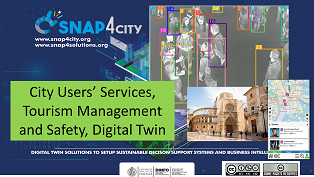
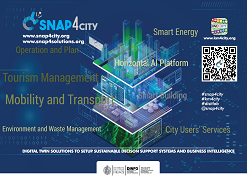

- Snap4City 8/2024 Artificial Intelligence Digital Twin services and tools offering catalogue
- archive of articles: https://www.snap4city.org/78
Solutions and Cases:
- SOLUTION: Smart Tourism Management with Snap4City PDF
- SOLUTION: 15MinCityIndex: understanding city areas by means of 13 different aspects, PDF
- SCENARIO: City Users' Participation and Engagement with Snap4City
- TOURISMO: TOURism Innovative and Sustainable Management of flOws
- Herit-Data and Snap4City: to better manage tourism flows, PDF
- Scenario: Herit-Data video and aims
- Florence HeritData FactSheet: https://www.snap4city.org/drupal/sites/default/files/files/FACTSHEET%20FLORENCE.pdf
- SOLUTION: 15MinCityIndex: understanding city areas by means of 13 different aspects, PDF
- SCENARIO: Fashion Retail Recommendation System via Multiple Clustering Approach
- Key performance Indicator: KPI per la mobilità e trasporti, MaaS, parcheggi, inquinamento (ITA)
- Social Media Analysis: Twitter Vigilance, PDF

The Tourism domain is one of the most complex. It includes city and service infrastructures, partially provided by the local governs and public entities (such as: the city itself, locations, museums, public transportation, beaches, parks) and partially from privates (such as: restaurants, shops, private travel means, guides, cruises, entertainments, fast foods, private parks and beaches). In most case, a certain level of competition may be present to attract Tourists, and in some cases to perform a better distribution due the occurrence of over-tourism conditions. A complete digital twin solution as Snap4City may effectively help to collect data, model and simulate behaviour, and produce real time monitoring, forecast, what-if analysis, and optimisations.
Snap4City has developed a large number of solutions to cope with the problems of Tourism domain, and the platform has been, and it currently is used in a number of cases/areas: Herit-Data Interreg, MobiMart Interreg, Tourismo Interreg, with pilots in large part of Europe: Florence, Valencia, Dubrovnik, Pont du Gard, Patra, Rhodes, Limassol, Bisevo, Malta, Mostar, Pisa, Varna, etc.
The main goals are to increase the quality of life/services, mitigate over tourism, reach the sustainability; reduction costs for services; improvement of accessibility to services for citizens, tourists, and commuters; maintaining under control the security/safety of all kinds of city users.
Snap4City supports the city public and private operators with solutions for the operational management and for the restoring and plan new and/or better services.
Solutions for Operation (monitoring, managing, mobile apps, digital signages, control rooms) may include: monitoring services: tickets, reputation, usages, areas, space allocations, etc.; Monitoring user behaviour (counting, trajectories): indoor/outdoor, hot places/services, ports, beaches; Computing: origin destination, trajectories, travel means, reputation, predictions, etc.; Early detection/warning of critical conditions, connection with Video Management Systems for security; Managing entrances in city areas: restricted areas, touristic busses, etc.; Production of info-tourism, recommendations, nudging to city users and operators, second offer promotion; Providing Virtual Assistants for City Services, Tourist Offices, etc.; Monitoring reputation of services via: social media, blogs, etc.; Collecting complains, requests, participations from city users via mobile apps, and other engagements; Computing predictions of any kind as: people coming/moving, services and sites reputation, advertising impact and people reactions.
Solutions for Planning (optimization and what-if analysis) may include: prediction of the effect of certain changes on the offer; Reduction of Pollutant Emissions, via optimization; Optimization plan to distribution of workload on multiple touristic offers/services, area cleaning, etc.; Predicting reputation of services, touristic and operative.
A large range of technical solutions have been tested, validated and setup in real conditions for counting, tracking and understanding people behaviour by using tv camera, pax counters, thermal cameras, mobile Apps, mobile data (origin destination matrices, people distributions by profiling), satellite data, sniffers as PAX counters on Wi-Fi and BT, drones, laser sensors, etc. Most of these solutions are producing data which are integrated by using Artificial Intelligence algorithms to produce deductions, hints, predictions, etc., for decision makers.
See also:
- TOURISMO Interreg: TOURism Innovative and Sustainable Management of flOws
- https://www.snap4city.org/1001
- Welcome to Varna (TOURISMO) https://www.snap4city.org/1031
- Welcome to Valencia (TOURISMO) https://www.snap4city.org/1036
- Welcome to Florence (TOURISMO) https://www.snap4city.org/1035
- Welcome to Malta (TOURISMO) https://www.snap4city.org/1034
- Welcome to Bisevo (TOURISMO) https://www.snap4city.org/1030
- Welcome to Limassol (TOURISMO) https://www.snap4city.org/1032
- Welcome to Rhodes (TOURISMO) https://www.snap4city.org/1034
- 15MinCityIndex: understanding city areas by means of 13 different aspects, Coverage whole Italy
- HeritData Interreg: https://www.snap4city.org/629
- Florence: https://www.snap4city.org/747
- Pont Du Gard: https://www.snap4city.org/740
- Valencia: https://www.snap4city.org/742
- Dubrovnik: https://www.snap4city.org/741
- Mostar: https://www.snap4city.org/744
- Mobimart Interreg: https://www.snap4city.org/642
- Feedback: Fashion Retail Recommendation System via Multiple Clustering Approach
- Smart Building with people counting, ISPRA JRC EC
- People Counting and tracking:
- PAX counting: https://www.snap4city.org/518
- People flow from Wi-Fi: https://www.snap4city.org/540
- Thermal Camera: https://www.snap4city.org/805
- CUNEO case Security and Safety: https://www.snap4city.org/975
