 |
SnapAssets |
AI-Powered GIS, Digital Twin and Intelligent Asset ManagementFrom knowing where assets are, to understanding their condition, predicting problems and orchestrating the actions needed to manage them. Snap4Assets is the GIS and intelligent Asset Management solution of the Snap4City ecosystem. It brings together GIS, asset inventories, buildings and facilities, IoT, BIM, maintenance processes, Business Intelligence, Artificial Intelligence, Digital Twins and Agentic AI in a single operational environment. The objective is to provide public administrations, infrastructure managers and operators with a continuously updated digital representation of their physical assets and their operational context. Instead of simply answering: “Where is this asset?” PDF: https://www.snap4city.org/download/video/snap4asset-2026-v04.pdf |
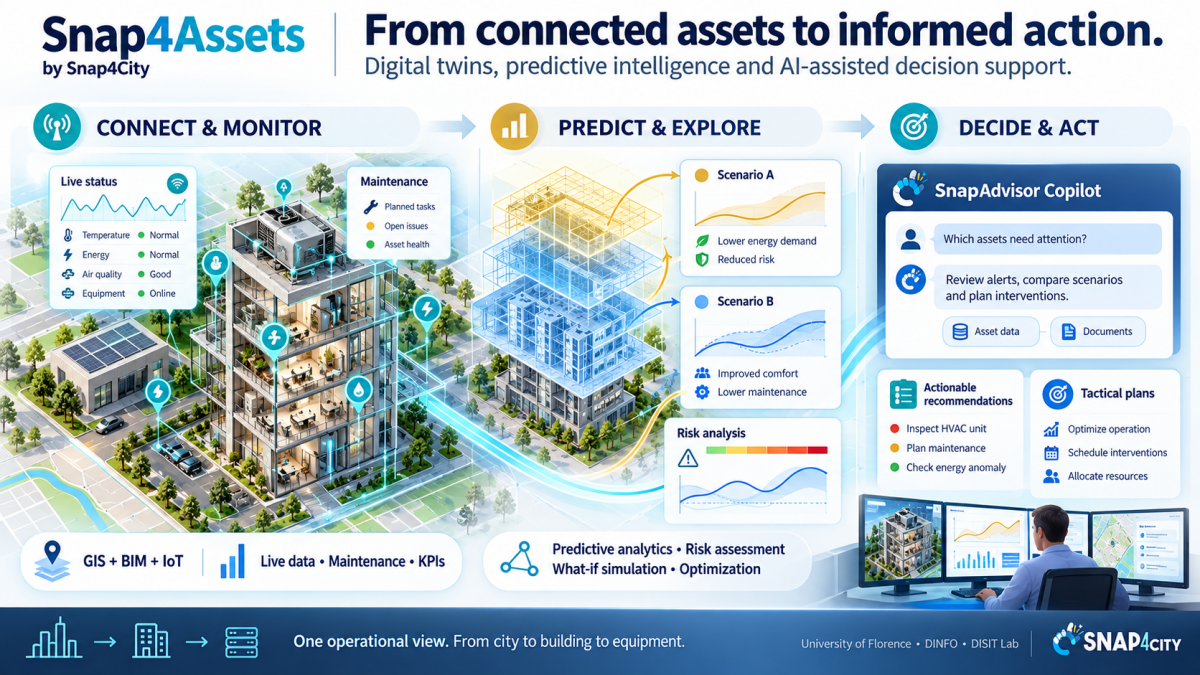
Snap4Assets progressively answers: Where is it? → What is it? → What is connected to it? → What is its current condition? → Who is responsible? → What happened in the past? → Is something abnormal? → What could happen next? → What should be investigated or done? This vision is enabled by the wider Snap4City platform, which is designed as a scalable, AI-based 2D/3D Digital Twin integrating GIS, IoT, BIM, satellite data, databases, services and operational processes for both real-time operation and tactical/strategic planning.
A Geographic Digital Twin of All Assets
Snap4Assets uses geography as the natural entry point for understanding infrastructure. Users can navigate from a global territorial representation down to increasingly detailed levels: City / Territory → Site → Building → Floor → Room / Area → Asset → Components and Sensors
Assets can be associated with geographical points, areas, building shapes, floors, rooms and BIM elements. Snap4City supports GIS maps, orthomaps, GeoTIFF, shapes, building plans, heatmaps, vector fields, 3D city models and BIM representations within the same Digital Twin model.
The platform supports both Global Digital Twins, representing the overall city or infrastructure network, and Local Digital Twins, providing detailed representations of individual buildings, facilities, machines or areas. Users can move from a city-level map into a detailed local representation, including 3D/BIM models and connected real-time information.
This allows Snap4Assets to manage not only municipal buildings but also distributed infrastructure, technical equipment, ICT infrastructure, street assets, cameras, sensors, energy systems and industrial or utility installations.
Complete Asset Inventory and Asset Context
Snap4Assets can create a unified asset catalogue covering fixed and mobile assets, buildings, infrastructure, technical systems, equipment and connected devices. An asset can be linked to its location, classification, technical characteristics, responsible persons, documents, photographs, sensors, historical information, maintenance processes and related assets. The Snap4City platform specifically identifies asset control for ICT devices, cameras, hosts, virtual machines, clusters, traffic gates, UPS equipment and other infrastructure. The broader Asset Control domain targets increased service availability, risk reduction, improved quality and reduced operational costs.
For buildings, the Digital Twin can model buildings, floors, rooms, parking, charging stations, gates and their functional allocation, while associating operational KPIs such as energy, occupancy, cleaning, environmental quality, departments, maintenance and equipment.
GIS + BIM + IoT in One Environment
Snap4Assets connects the traditionally separate worlds of GIS, BIM and IoT. GIS provides the territorial and spatial context. BIM provides the detailed structural representation of buildings, floors and components. IoT provides the dynamic operational condition of physical assets as sensors, devices, entities. And Support High Level Types: traffic flows and animations, ODM, trajectoris, synoptics, video cams, heatmaps and animations, flowfields, and several others kind of data models according to several standards: MDS, FIWARE, Smart data models of snap4city, etc.
Snap4City can associate BIM elements with platform entities and ServiceURIs, connect them to sensors and allow users to move between maps, buildings, BIM elements and operational data. The result is a Digital Twin in which a user can move conceptually: Map → Building → BIM → Equipment → Sensor → Historical Trend → Alarm → Maintenance information rather than navigating several disconnected applications.
Real-Time Monitoring and Control
Snap4Assets is not limited to static asset records. Connected assets can provide real-time status, operational variables, health information and historical time series. Dashboards can monitor values, events, alarms, conditions, predictions and early warnings. This enables infrastructure managers to monitor equipment such as switches, Wi-Fi systems, servers, UPS systems, sensors, cameras, buildings and energy systems and rapidly identify abnormal or unavailable components. Dashboards can also contain actuators. Therefore, when permitted by the underlying system and security rules, the environment can move beyond monitoring to control and action, sending commands through the IoT and processing infrastructure.
Intelligent Alarms and Early Warning
Operational information can be processed to identify critical conditions. Snap4City supports event-driven processing, anomaly detection, KPI thresholds, predictions and early-warning mechanisms. Events can activate dashboards, processes, maintenance tickets, notifications or actuators. Multichannel notifications can be delivered through channels such as email, SMS, Telegram and mobile applications, according to the implemented workflow. In a Control Room, an alarm can also dynamically change the information displayed to operators, focusing dashboards or even video walls on the relevant operational context.
Maintenance and Facility Management
Snap4Assets can extend from asset monitoring into maintenance and facility-management processes. The extended maintenance environment can cover preventive and corrective maintenance, buildings and technical plants, logistical assets, spare materials, warehouse information, suppliers, contracts, budgets and energy-consumption information. The system can maintain historical changes, attach documents to asset records, support customised searches and views, generate reports, use QR/barcodes for asset identification, support mobile access and integrate external applications through web services.
Business Intelligence for Asset Managers
Snap4Assets transforms operational asset data into management intelligence. Dashboards can combine maps with KPIs, tables, trends, gauges, charts, heatmaps, trajectories, alarms, predictions and other visual analytics. The Snap4City Dashboard environment is specifically designed for operators, decision makers, Situation Rooms and Control Rooms, and supports both operational monitoring and strategic analysis. Interactive dashboards can perform drill-down, filtering, faceting, searching and cross-analysis. A manager can start from a global KPI, select an area, identify a building, drill down to a specific equipment category and inspect the corresponding assets or historical events. Maintenance data can also be analysed through Business Intelligence to understand classifications of interventions, replaced or repaired components, failure patterns and impacts on infrastructure operation. This transforms maintenance records from an administrative archive into information for asset strategy, investment planning and service-quality improvement.
AI for Predictive Asset Management
Snap4Assets can exploit the complete Snap4City AI and Data Analytics environment. Snap4City supports Machine Learning, Deep Learning, Generative AI, LLMs, XAI, statistics, optimisation and other advanced analytics for prediction, anomaly detection, classification, critical-condition detection, suggestions and decision support. In an asset-management context, these capabilities can support use cases such as: asset-health prediction, anomaly detection, predictive maintenance, failure-risk analysis, consumption forecasting, identification of unusual behaviour, SLA, optimisation of maintenance resources and prioritisation of interventions.
The platform explicitly covers predictions and anomaly detection and identifies predictive maintenance as an operational capability in industrial asset-management scenarios. AI models can be developed in Python or R and operationalised through the platform. MLOps support allows models to be deployed and managed on CPU/GPU clusters or HPC infrastructures and exposed as services through APIs.
Explainable AI for Managers
In asset and infrastructure management, a prediction alone is often insufficient. Managers need to understand why the system is raising an alert or recommending an intervention. Snap4City supports Explainable AI approaches designed to make predictions and prescriptions understandable to decision makers, supporting technical and organisational assessment rather than treating AI as an unexplained black box. This is particularly valuable when AI recommendations influence expenditure, maintenance priorities, safety or service continuity.
What-If Analysis, Simulation and Optimization
Snap4Assets can also support asset managers in moving from operational monitoring to planning and scenario evaluation. The Snap4City What-If environment allows scenarios to be created, saved and shared and can combine Digital Twins, Business Intelligence, analytics and simulations to answer questions of the form: “What could happen if we change this condition?” For asset and facility management, the same approach can be used to develop scenarios concerning energy, service capacity, infrastructure availability, asset deployment, maintenance strategies or other asset-related KPIs where the appropriate models are available. The broader Snap4City simulation framework supports co-execution of heterogeneous models and can operate both offline and in near-real-time environments, with scalable containerised execution. This provides the technological basis for progressing from: Monitor → Predict → Simulate → Compare → Optimize → Decide
SnapAdvisor: The AI Expert for Assets and Operations
SnapAdvisor introduces a multilingual conversational AI layer into the Snap4Assets environment. Organisations can provide their own technical documents, maintenance manuals, regulations, contracts, procedures, PDFs, slides, web pages and other controlled information and create a specialised AI advisor. SnapAdvisor uses an Advanced RAG approach, allowing it to work with updated organisational information without retraining the underlying model. Responses can be grounded in retrieved content and can include references to the source material. Access to knowledge collections can also be controlled by user or team.
For Snap4Assets, this creates possibilities such as:
- “What is the maintenance procedure for this asset?”
- “Show me the documentation related to this building.”
- “What does the contract specify for this type of intervention?”
- “Summarise the previous incidents affecting this equipment.”
- “Explain this technical alarm to me.”
- “Which procedure should the operator consult before intervening?”
Different teams can have separate curated collections for maintenance, safety, engineering, contracts or operations.
Agentic AI: From Answering Questions to Performing Investigations
Snap4Assets can be further enhanced by the agentic AI architecture developed within the Snap4City ecosystem. The multi-agent framework described in the attached research can translate a natural-language objective into a multi-step plan, select specialised agents, invoke platform microservices and APIs, correlate the retrieved results and generate a grounded response.
This changes the interaction from: User → Application → Search → Database → Dashboard → Analysis to: User Objective → AI Planner → Specialist Agents → Tools & Data → Correlation → Explanation → Decision Support
For Snap4Assets, specialised agents could progressively address domains such as GIS, assets, buildings, IoT, maintenance, documents, energy, security and KPIs. A manager might ask: “Which critical assets in this site require attention and why?”
An agentic workflow could combine asset inventories, GIS position, IoT health, alarms, historical trends and related documentation before presenting the results. The framework also includes supervision, retries and replanning mechanisms rather than relying on a single uncontrolled LLM response. Thus, the long-term vision is not merely AI that talks about assets, but AI that knows which authorised tools and data sources need to be consulted to investigate an asset-management objective.
Semantic Knowledge Graph and Intelligent Asset Relationships
A major differentiator of Snap4City is its Knowledge Base based on the Km4City ontology.
Instead of simply putting heterogeneous information into a common data lake, the platform establishes semantic relationships between entities, geography, time, processes and users. For Snap4Assets this means that an asset can be understood in context: Asset → is located in → Room → belongs to → Floor → belongs to → Building → belongs to → Site
while at the same time being connected to: Sensors → Responsible Persons → Processes → Dashboards → Documents → Maintenance Tickets → KPIs
The Entity/Data Inspector helps operators and administrators explore these relationships and understand which data, applications, dashboards and processes depend on particular resources. This is especially valuable for impact analysis: a problem with one data source, device or service can be traced to the applications and processes that depend upon it.
Broad Interoperability — Protect Existing Investments
Snap4Assets is designed to integrate existing systems rather than force their replacement. The Snap4City platform supports more than 190 interoperability mechanisms, protocols and formats spanning IoT, GIS, databases, industrial systems and web services. Examples include: WFS/WMS, GeoJSON, SHP, GeoTIFF, IFC, NGSI, MQTT, AMQP, CoAP, LoRaWAN, OPC/OPC-UA, ModBus, REST, HTTPS, WebSocket, ODBC/JDBC, Oracle, PostgreSQL, MySQL, MongoDB, CKAN, OSM and Copernicus. Existing ArcGIS, QGIS and GeoServer environments can exchange information through standard GIS protocols, while BIM servers, ERP/BPM systems, external applications, databases and video-management platforms can be integrated through APIs and Processing Logic. This allows an administration to maintain its existing master systems while Snap4Assets provides the common GIS, Digital Twin, BI and AI operational layer above them.
APIs, Microservices and Visual Integration
Snap4City provides Smart City APIs supporting spatial, temporal and relational queries as well as access to time series, files, heatmaps, Digital Twin information and analytical services. AI and simulation processes can also be exposed through the platform's API environment. For process integration, Snap4City provides Proc.Logic / IoT Apps, based on Node-RED and Snap4City microservices. More than 200 specialised microservices support data ingestion, transformation, entity management, analytics, GIS operations, events, dashboards, IoT, maintenance workflows, BIM, external services and AI. This visual programming environment allows new workflows and integrations to be created with limited coding, while advanced developers can integrate Python, JavaScript, R and external services where required. Snap4Assets can therefore be adapted to the processes of different cities and organisations without developing every integration from scratch.
Mobile and Field Operations
Snap4Assets can support operators in offices, Control Rooms and the field. The underlying platform supports Web applications, mobile applications, dashboards, tablets, digital signage and other interfaces. Maintenance functionality can also be delivered through mobile devices for field execution. QR and barcode identification can be associated with asset-management processes, enabling technicians to identify equipment rapidly and access the corresponding information. This provides a direct connection between the physical asset in the field and its Digital Twin.
Security, Governance and Role-Based Access
Snap4Assets inherits the security and governance architecture of Snap4City. The platform is designed for GDPR-compliant management of data and allows access to resources to be granted, delegated and revoked according to ownership and authorization rules. It is compliant with RBAC and ACL standards and also include tools for API management and accounting. Different profiles can therefore be established for managers, operators, maintenance teams, GIS staff, infrastructure specialists, contractors and administrators. Snap4City supports organisational separation, resource ownership, delegation, auditing and special authorisations. This enables the same Digital Twin to provide different views according to responsibilities and sensitivity of the underlying information.
Scalable, Open and Deployable Anywhere
Snap4Assets benefits from a 100% open-source, modular and scalable platform architecture. Snap4City can be installed on-premise or on public/private cloud infrastructures and can scale from small vertical installations to city- and regional-scale deployments. Docker and Kubernetes-based configurations are supported. Edge processing is also supported, allowing Processing Logic to operate close to devices or facilities when latency, connectivity or operational requirements demand it. Federation allows multiple Snap4City installations to create cross-city or cross-area environments while individual organisations retain control over what they share.
Platform Monitoring and Operational Reliability
Snap4Assets can also exploit Snap4City Sentinel for monitoring the health of the platform itself. Sentinel monitors containers, services and infrastructure status, provides health checks and logs, and can issue alerts when services are unavailable or fail validation tests. The back office also provides facilities for user administration, auditing, API monitoring, data-flow monitoring, resource-consumption control and platform quality control. This means that Snap4Assets does not only monitor the city's assets: the operational team can also monitor the health of the digital infrastructure used to manage those assets.
Snap4Assets Functional Coverage
Snap4Assets can therefore combine the main capabilities of the Snap4City ecosystem into a single asset-centred solution:
- GIS & Spatial Asset Management: maps, orthomaps, layers, POIs, shapes, search, measurements, geospatial queries and spatial relationships.
- 2D/3D Digital Twins: city, site, building, floor, room, plant and individual-asset representations.
- BIM Integration: IFC-based models, BIM elements connected to assets, sensors and GIS.
- Asset Inventory: buildings, facilities, equipment, ICT devices, sensors, cameras, UPS, servers, infrastructure and mobile assets.
- IoT/Wot Device Monitoring & Control: real-time values, historical time series, sensors, actuators and remote operational status.
- Maintenance Management: preventive/corrective maintenance, tickets, assignments, workflows, feedback and intervention histories.
- Facility & Logistics Management: spaces, warehouses, materials, suppliers, contracts, costs and energy.
- Business Intelligence: operational and management KPIs, trends, drill-down, filtering, faceting and comparative analysis.
- Control Rooms: H24 monitoring, alarms, dashboards, maps, cameras and context-driven operational displays.
- AI & Predictive Analytics: prediction, anomaly detection, classification, predictive maintenance and risk assessment.
- Explainable AI: explanations supporting transparent managerial decisions.
- What-If & Simulation: scenarios, simulation, alternative configurations and impact assessment.
- Optimization: support for identifying better configurations according to selected KPIs and constraints.
- SnapAdvisor CoPilot: private, Agentic AI, multilingual RAG-based AI assistant grounded in organisational knowledge.
- Agentic AI: multi-agent orchestration of authorised data, APIs and services for complex investigations and decision support.
- Knowledge Graph: semantic relationships among assets, spaces, people, data, processes and applications.
- Data Inspector: discovery, health analysis, dependency analysis and traceability.
- Workflow & Business Logic: Node-RED visual programming and more than 190 Snap4City microservices.
- Interoperability & APIs: integration with GIS, BIM, ERP, BPM, databases, IoT, open-data platforms and third-party systems.
- Video & Security Integration: camera and Video Management System integration.
- Events & Notifications: automated alarms and multichannel communication.
- Mobile & Field Support: web/mobile access, QR/barcodes and operator applications.
- Security & Governance: SSO, authentication, authorisation, ownership, delegation, auditing and GDPR controls.
- Open Data & Data Spaces: CKAN, APIs, shared/federated information and open standards.
- Cloud, On-Premise & Edge: modular deployment from a single organisation to regional-scale systems.
- Federation: connection of multiple cities, organisations or operational areas.
- Platform Supervision: Sentinel, service health, logs, resources and API monitoring.
- Open Source & Extensible Architecture: protection against vendor lock-in and continuous extension with new asset classes, services, analytics and AI.
One Platform for Managers and Operators
For City and Asset Managers, Snap4Assets provides the strategic view: asset portfolio → condition → performance → costs → risks → KPIs → predictions → priorities → investment decisions.
For Operators, it provides the operational view: find asset → understand context → check status → analyse alarm → access documentation → create or manage intervention → update information → close the action.
For technical departments and developers, it provides the integration environment: connect systems → model entities → build workflows → expose APIs → create dashboards → develop analytics and AI → automate processes.
From Asset Registry to Intelligent Asset Operations
The evolution enabled by Snap4Assets can be summarised as:
- GIS Where is the asset?
- Asset Registry What is it and who is responsible?
- Digital Twin How is it connected to the territory, building and other assets?
- IoT Monitoring What is happening now?
- Maintenance Management What interventions have been or must be performed?
- Business Intelligence What do the history and KPIs tell us?
- Predictive AI What is likely to happen next?
- SnapAdvisor What does our technical and organisational knowledge say?
- Agentic AI Which authorised data, tools and analyses should be orchestrated to investigate the problem?
- Decision Support What should managers and operators consider doing next?
Read more on:
- Snap4City vs GIS solutions and connections, Version 2
-
Smart City Digital Twin by Snap4City, 2026 version
-
IOT Directory and Devices
- https://www.snap4city.org/download/video/course/p3/
-
Part 3: IOT App, Process Logic, Server Side Business Logic, SLIDES, Interactive Slides
-
DI-DTPlatform: Domain-independent Digital Twin technological platform
-
Long Term Prediction of NO2 KPI of European Commission reference values
-
Prediction API
-
Data Analytic: Predicting Air Quality
-
Long Term Prediction of NO2 KPI of European Commission reference values
-
Available Bikes and Free Slots Prediction On Bike Sharing Stations
-
SnapAdvisor: A LLM Expert at your disposal H24/7 on Snap4City and your private content.
-
Decision Support Engines and Models: SmartDS, ResilienceDS
-
CAI4DSA: Collaborative Explainable neuro-symbolic AI for Decision Support Assistant, FAIR PE1 Spoke 1, PNRR
-
CAI4DSA: Collaborative explainable neuro-symbolic AI for Decision Support Assistant
-
SADI-MIAC: Integrated Decision Support System with Digital Twin Models and Artificial Intelligence for Business
- SOLUTION: Agentic AI for Natural-Language Access to Snap4City Data and Services
